St. Charles Borromeo: Life, Feast Day (November 4) & Prayer
Quick answer
St. Charles Borromeo (1538–1584) was the cardinal archbishop of Milan who put the reforms of the Council of Trent into practice: he founded seminaries, taught the faith to children and adults, and stayed in Milan to care for the sick during the plague of 1576. His feast is November 4, and he is a patron of catechists, seminarians and bishops.
Key takeaways
- St. Charles Borromeo was born in 1538 and died in Milan on November 3, 1584; his feast is November 4.
- As a young cardinal he helped bring the Council of Trent to a close and worked on the Roman Catechism.
- As Archbishop of Milan he founded seminaries, schools of Christian doctrine and the Oblates of St. Ambrose.
- During the plague of 1576–1578 he stayed with his people, visiting the sick and feeding the hungry.
- He is a patron of catechists, seminarians and bishops, and an example of reform that begins with oneself.
St. Charles Borromeo was the cardinal archbishop of Milan who did more than almost anyone to put the Council of Trent into practice. Born into a powerful family in 1538, he gave up a life of privilege to rebuild his diocese: he founded seminaries, taught the faith to children and adults, and stayed in Milan to care for the sick during a terrible plague. The Church celebrates his feast on November 4, and he is a patron of catechists, seminarians and bishops.
Who Was St. Charles Borromeo?
Charles was born on October 2, 1538, in the castle of Arona, on the shores of Lake Maggiore in northern Italy. His father was Count Gilbert Borromeo, and his mother, Margaret, belonged to the Medici family of Milan. From childhood he was known as serious and devout, and he was given the clerical tonsure at the age of twelve.
He studied civil and canon law at the University of Pavia and received his doctorate in 1559. That same year his mother’s brother was elected pope as Pius IV. The new pope called his nephew to Rome and, in 1560, made him a cardinal at just twenty-one years old, entrusting him with major responsibilities in the government of the Church.
In an age when such appointments were often a road to wealth, Charles chose another path. The sudden death of his elder brother Federico in 1562 deeply affected him. Rather than return to family life, as many expected, he was ordained a priest in 1563 and, shortly after, a bishop. From then on he lived with growing simplicity and devotion, taking the word Humilitas (humility) as his motto.
His Role in the Council of Trent
The Council of Trent (1545–1563) was the Church’s great response to the crisis of the Protestant Reformation. When Pius IV reopened it for its final sessions, Cardinal Borromeo worked tirelessly in Rome to keep it moving and to bring it to a successful conclusion in 1563.
After the Council, he helped oversee the preparation of the Roman Catechism (often called the Catechism of the Council of Trent, published in 1566), written to help priests teach the faith clearly. Today’s Catechism of the Catholic Church stands in the same tradition of giving the faithful a reliable summary of what the Church believes.
Archbishop of Milan: Reform Begins at Home
Milan had been governed for decades by archbishops who lived far away. Charles insisted on living among his people, and after the death of Pius IV in 1565 he settled in Milan for good. What followed was one of the most thorough renewals of a diocese in Church history:
- Seminaries. Following Trent, he founded seminaries to form priests properly in doctrine, prayer and pastoral care.
- Catechesis for everyone. He supported the Confraternity of Christian Doctrine, whose Sunday schools taught thousands of children and adults the basics of the faith.
- Visiting every parish. He traveled, often on foot or by mule, to the most remote valleys of his enormous diocese to see conditions for himself.
- Synods and clear rules. He held regular diocesan and provincial synods to apply the Council’s decrees.
- Priests who serve. In 1578 he founded the Oblates of St. Ambrose, secular priests who offered themselves to the bishop for any service.
His reforms were not always welcome. In 1569 a member of a religious order he was trying to reform fired a shot at him while he knelt in prayer in his chapel. The bullet struck him but did not wound him seriously. Charles forgave his attacker and continued his work.
He also began with himself. He sold or gave away much of his wealth, ate simply, slept little, and gave generously to the poor. His example made his reforms believable.
Charles Borromeo and the Plague of 1576
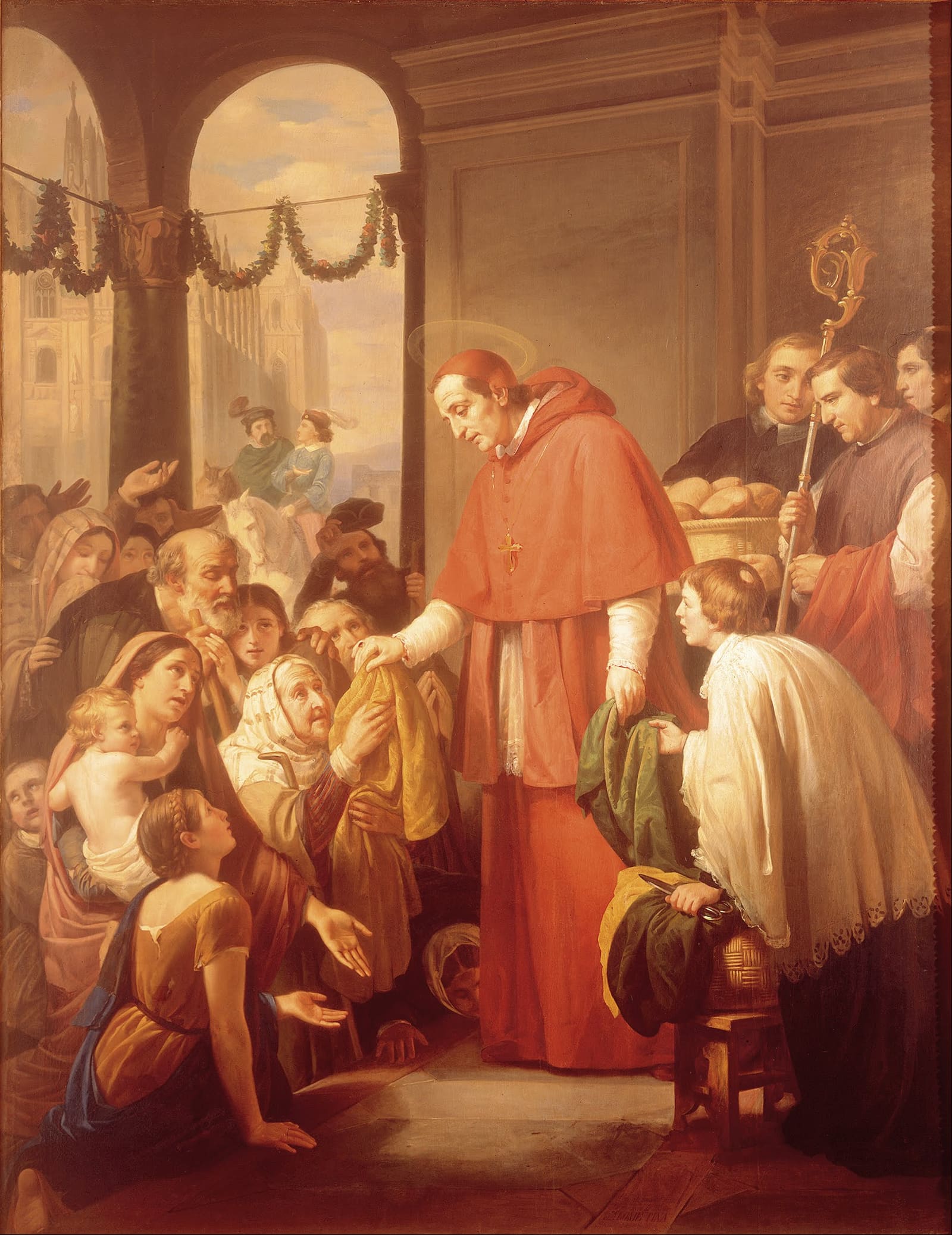
In 1576 plague struck Milan. Many of the city’s officials and nobles fled. The archbishop stayed. He visited the sick and dying, organized care for the infected, fed thousands of hungry people each day, and spent his own money and possessions to help them, even taking on debt. He led processions of penance through the streets, walking barefoot with a rope around his neck, and asked God to spare the city.
The epidemic lasted into 1578 and is still remembered in Milan as “the plague of St. Charles.” His courage is a reminder that pastors belong with their flock, especially when it suffers. Many people still pray for those who died in such tragedies; our prayer for the souls in purgatory is a good way to remember them, especially in November.
His Death and Canonization
Worn out by his labors, Charles died in Milan on November 3, 1584, at only forty-six years of age. He was buried in Milan Cathedral, where his body is still venerated in the crypt. Pope Paul V canonized him in 1610, just twenty-six years after his death. Because November 3 is so close to All Saints and All Souls, his feast is kept on November 4.
What Is St. Charles Borromeo the Patron Saint Of?
St. Charles is traditionally invoked as the patron of:
- Catechists and teachers of the faith
- Seminarians and those preparing for the priesthood
- Bishops and spiritual directors
- Those who care for the sick, remembering his service during the plague
Many seminaries are named after him, including St. Charles Borromeo Seminary in Philadelphia, founded in 1832.
Prayer to St. Charles Borromeo (Original Prayer)
St. Charles Borromeo, faithful shepherd of the Church,
you gave up wealth and comfort to serve Christ and his people.
Pray for our bishops and priests,
that they may be holy, humble and close to their flock.
Pray for all who teach the faith,
that they may hand on the truth with patience and love.
Pray for the sick and for all who care for them,
as you cared for the suffering of Milan.
And obtain for me the grace to begin the reform of the Church
with the reform of my own heart.
Amen.
How to Celebrate His Feast Day
- Pray for your priests and bishop, by name if you can. Charles spent his life forming good priests.
- Thank a catechist. Write a note to someone who taught you or your children the faith.
- Learn something about your faith. Read a few paragraphs of the Catechism, or one of our Catholicism 101 articles.
- Serve the sick. Visit or call someone who is ill or alone.
- Make a good confession. Charles believed real reform starts with conversion; our guide on how to go to confession can help.
What St. Charles Teaches Us Today
St. Charles Borromeo lived in a time of scandal and division in the Church, not unlike our own. He did not respond with complaints but with work and holiness: teaching, praying, visiting, serving and beginning with his own life. His example reminds us that, as the Church teaches, the saints are “the models and intercessors” God gives us (CCC 828), and that renewal always starts with one converted heart. To learn more about following their example, read 3 ways to live like a Catholic saint and why Catholics pray to saints.
St. Charles Borromeo, pray for us.
Frequently asked questions
What is St. Charles Borromeo the patron saint of?
St. Charles Borromeo is the patron of catechists, seminarians, bishops and spiritual directors, because he devoted his life to forming priests and teaching the faith. Many seminaries around the world bear his name. He is also invoked by those who care for the sick, remembering his heroic service during the plague in Milan.
When is the feast of St. Charles Borromeo?
His feast is November 4, the day after his death on November 3, 1584. It is an obligatory memorial in the General Roman Calendar, so it is celebrated at Mass throughout the Church unless it falls on a Sunday.
Why is St. Charles Borromeo important?
He was one of the main figures of the Catholic Reformation. After the Council of Trent, he showed how its decrees could renew the Church in practice: well-formed priests, regular catechesis, frequent preaching and bishops who live among their people. Later bishops looked to Milan as a model.
Was St. Charles Borromeo really made a cardinal at 21?
Yes. His uncle, Pope Pius IV, made him a cardinal in 1560 when he was only twenty-one and gave him important duties in Rome. Instead of using his position for comfort, Charles took his responsibilities seriously, was ordained a priest and bishop, and devoted himself to the reform of the Church.
Sources
- Roman Martyrology and General Roman Calendar, November 4
- Catholic Encyclopedia (1908), St. Charles Borromeo
- Catechism of the Catholic Church, 828 (canonized saints as models and intercessors)